Melville W. Fuller
Life Story: 1833-1910
The Maine-born attorney who guided the Supreme Court through industrialization preserved judicial harmony as Chief Justice .
Background
Melville Weston Fuller was born in Augusta, Maine on February 11, 1833. He was the youngest of two sons born to Frederick A. Fuller and Catherine Weston Fuller. Frederick was an attorney, and Catherine’s father was a Chief Justice of the Maine Supreme Court—a family legacy that gave Melville an early connection to the law. After the couple divorced, Catherine and her two young boys went to live with her parents. Without Frederick’s income, she needed to rely on her family for financial support and stability. She remarried 11 years later, though Melville continued to live with his grandparents.
In 1849, at 16, Melville enrolled at Bowdoin College in Brunswick, Maine. He received a classical education, mainly taught in Greek and Latin, and dedicated time to his lifelong love of poetry and literature. As a member of Athenian Society, a campus literary club, Melville read more books in the Society’s 5,000-volume library than any other student during his four years in college. His grades earned him election to the prestigious honor society Phi Beta Kappa, and he received his degree in 1853. Melville stayed connected to Bowdoin throughout his life, rarely missing a graduation and serving as commencement speaker on many occasions. He received an appointment to the school’s Board of Trustees in 1894—a position he served in until his death in 1910.
Early Career
During and after his graduation from college, Melville combined his interests in literature and politics by working as the editor of Age, a Maine Democratic newspaper. Both sides of his family had strong ties to the Democratic Party that guided his entire career. Additionally, his mother always hoped Melville would follow in the footsteps of other family members and practice law. Following her untimely death just before his college graduation, Melville kept the vow he made with her to join the profession. He attended law lectures at Harvard University for six months in the fall of 1854 before moving to Bangor, Maine, to read law in an attorney’s office. Law school was not a requirement for attorneys at the time, and most practicing lawyers prepared for the career by reading law. After the Maine Bar admitted Melville in 1855, the city of Augusta appointed him city solicitor and elected him president of the Common Council.
Melville left Maine for Chicago in 1858 after his first fiancée called off their engagement. The same year, he married Calista Reynolds, with whom he had two daughters before her untimely death from tuberculosis in 1864. In Chicago, Melville established a thriving law practice where he represented a variety of banks, real estate interests, railroads, and elite members of the Chicago business community. The young lawyer also became an active member of the local Democratic Party. He staunchly supported Stephen Douglas, who defeated future President Abraham Lincoln for an Illinois Senate seat in 1858. In the midst of the Civil War, Melville successfully campaigned for a seat in the Illinois House of Representatives in 1863. Though Melville supported the Union, he was a sharp critic of President Lincoln and denounced the Emancipation Proclamation as an unconstitutional overreach of presidential power. Although Melville remained loyal to his Democratic ideals, his talent for reaching across party lines and establishing relationships with people of different opinions defined his career as a state representative. After serving one term, he returned to his law practice, which continued to flourish throughout the 1860s and 70s. In 1866, he remarried, to Mary Ellen Coolbaugh, the daughter of a prominent Chicago banker. The couple had eight children together, seven of whom survived childhood. Melville, who had made a fortune practicing law and in real estate, enjoyed indulging his children, especially his daughters, who all remembered him as an attentive father.
The Supreme Court
In 1884, the United States elected Grover Cleveland, the first Democratic president after the Civil War. Melville, a longtime political supporter of Cleveland, received multiple offers to join the new administration. He turned down each position. Accepting would mean leaving his lucrative law practice in Chicago and moving his family across the country to Washington, D.C. to start a new life—and on a much smaller salary. At the time, Melville earned $20,000 annually through his private practice, while the average salary of a top government position was about $8,000 per year. Finally, President Cleveland approached him with the role of Chief Justice of the United States. Though Melville asked for time to think about accepting the position, the President sent his name to the Republican-dominated Senate immediately. For Cleveland, the timing was crucial: the 1888 presidential election was only six months away, and a new president from a different party could derail the sitting President’s nomination. The Senate confirmed Melville’s appointment on July 20 by a split vote of 41-20. The popular magazine Harper’s Weekly declared that Chief Justice Fuller went “to the bench with probably a wider experience of all branches of the law than has been enjoyed at the bar by any member of the Court.”
Chief Justice of the United States
The Fuller family moved into a large brick mansion in Washington, D.C., where the Chief Justice frequently hosted the Justices’ weekly conference on Saturdays. At the time, the Supreme Court met in the Capitol building’s old Senate chamber, and the Fuller house was much more spacious. Melville, a kind and gentle man, and his wife also enjoyed hosting welcome dinners for new Justices and their wives in their home.
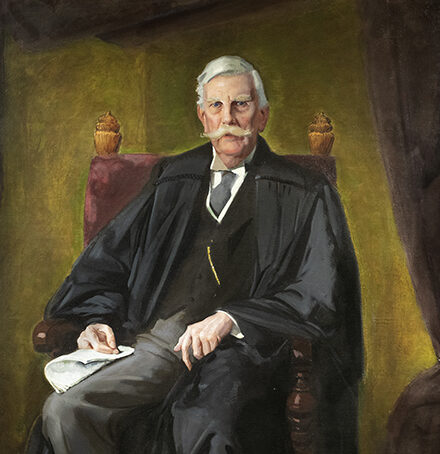
Early on, some Justices questioned whether Melville was the right choice for Chief, but he quickly won them over. The Associate Justices Samuel Miller and Oliver Wendell Holmes, who each served under four different Chief Justices, “found Fuller to be the most successful Chief Justice they had known.” Like Chief Justice John Marshall, who was known for establishing the Supreme Court’s judicial authority, Fuller aimed to achieve as many unanimous opinions as possible. Despite standing just 5 feet 1 inch tall, he commanded strong leadership and united the Court. The Justices only filed dissenting opinions in 2.3 percent of decisions handed down during his tenure.
When it came to assigning opinions, one of the duties of the Chief Justice, Fuller initially kept major decisions for himself, as was typical until that point. Later on, though, he departed from tradition and assigned significant cases to other Justices. Associate Justice David Brewer said “the duty of assigning cases is a most delicate one and could, if unwisely discharged, provoke no little irritation.” He complimented Chief Justice Fuller, saying that “no one could be more fair and wise than he in such distribution.” This was just one way the Chief Justice worked to promote unity. He also established the practice of having Justices shake hands with each other before conference and each session of the Court, a tradition that continues today.
Judicial Reform
While Chief Justice Fuller generally succeeded in uniting the Court, he struggled to balance the workload and the demands of Washington society. Today, the Supreme Court operates mostly as an appellate court. It has substantial discretion on which cases it chooses to hear, and hears between 70 and 80 cases per year. At that time, however, the Court had to hear every case appealed to it that involved a federal law. The sheer volume of cases exhausted the Justices. In addition, the Justices rode circuit and were expected to attend social events with Washington’s elite. In May 1890, Chief Justice Fuller told the Court’s reporter that he was “so weary that I can hardly stand up.”
Seeking to ease the burden on the federal judiciary, the Chief Justice supported efforts to reform the courts. Melville spoke about creating new courts to George Edmunds, chair of the Senate Judiciary Committee. Within the year, Congress passed the Evarts Act of 1891, which established the intermediate appellate courts and phased out circuit riding. The legislation also limited the categories of cases that could routinely be appealed to the Supreme Court, directing cases on topics such as patent, criminal and admiralty law to these intermediate courts. For the first time the Justices had some freedom to choose the cases the Court would decide. The new Courts of Appeals effectively reduced the workload of the Supreme Court.
Rights
Chief Justice Fuller oversaw the Court as the nation navigated massive social and economic transformations. Nearly three decades after the Civil War, the country remained divided over issues of race and civil rights. In 1896, Fuller joined the 7-1 majority in Plessy v. Ferguson, which legalized racial segregation and legitimized Jim Crow laws.
Commerce
At the same time, rapid industrialization generated a number of challenges to newly created economic regulations. Under Chief Justice Fuller’s leadership, the Court issued decisions that generally recognized and protected the rights of businesses and property owners. In United States v. E.C. Knight Company (1895), the Court reviewed the federal government’s attempt to break up an alleged sugar refining monopoly using the newly enacted Sherman Antitrust Act. The case challenged to what extent the Constitution’s Commerce Clause allowed Congress to use laws, like the Sherman Act, to regulate interstate trade (and in this case, break up the sugar refining giant). Chief Justice Fuller authored the 8-1 opinion holding that Congress could regulate travel and trade between states, but that industry and agriculture were under state control. As a result, the federal government could not use the Sherman Act against the sugar refining company. The holding highlighted Chief Justice Fuller’s commitment to federalism by recognizing a balance between federal authority and state autonomy.
In 1908, the Court heard another challenge to the Sherman Act when a labor union, the United Hatters of North America, boycotted the D.E. Loewe & Company. The nationwide event successfully reduced sales at both Loewe’s, and companies that sold Loewe’s products. In the unanimous opinion, Chief Justice Fuller declared that the boycott contributed to “restraint of trade or commerce among the several States.” The decision confirmed federal protection of interstate commerce, though it weakened the growing labor movement.
Reform
The Supreme Court heard numerous challenges to reform legislation at the turn of the century. In 1895, for example, the Court reviewed the constitutionality of a personal income tax. Chief Justice Fuller concluded in Pollock v. Farmers’ Loan & Trust Company that “nothing can be clearer than what the Constitution intended to guard against was the exercise by the general government of the power of directly taxing persons and property within any State….” Therefore, the income tax law was unconstitutional. Though the Court’s majority opinion demonstrated judicial restraint, Fuller also noted that Congress could amend the Constitution to allow for a federal income tax. Less than 20 years after the Pollock decision, the states ratified the Sixteenth Amendment, which gave Congress the power to levy and collect taxes on income.
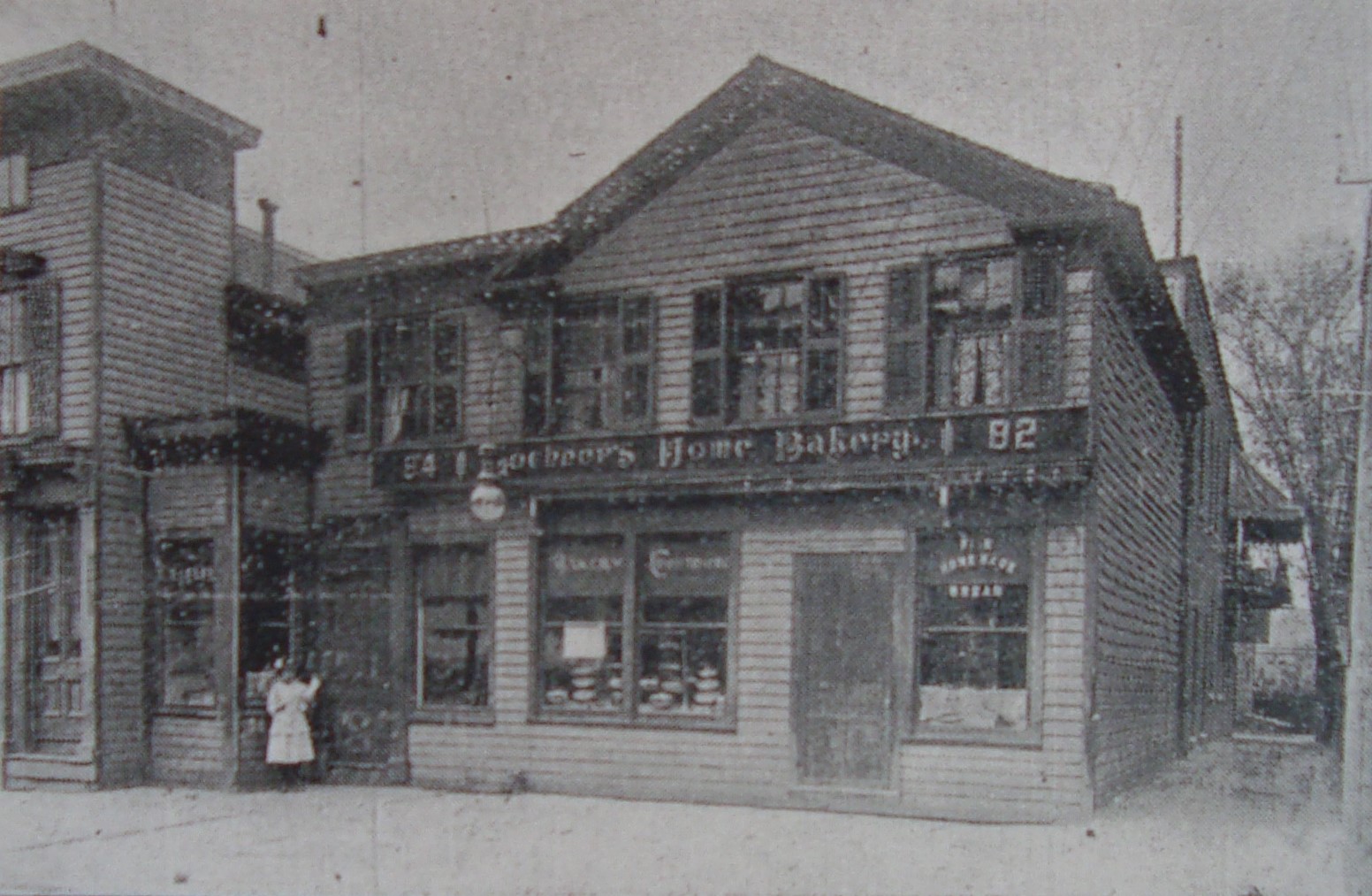
In 1905, Chief Justice Fuller joined a 5-4 majority in Lochner v. New York, which invalidated a New York law that limited working hours for bakery employees. Associate Justice Rufus Peckham wrote for the Court, “the statute necessarily interferes with the right of contract between the employer and employee,” which the Fourteenth Amendment guaranteed. The holding concluded that bakery working conditions did not compromise workers’ health and safety. Therefore, the New York Bakeshop Act was an overreach of the state’s power.
Off the bench, Melville was interested in treaties and international law. President Cleveland offered Melville the position of Secretary of State in 1893 during his second term in office. Although honored by the proposal, Chief Justice Fuller turned the president down, saying that “surrendering of the highest judicial office in the world for a political position, even though so eminent, would tend to detract from the dignity and weight of the tribunal.” Melville did, however, become one of the first American representatives to serve on the Permanent Court of Arbitration. Established in 1899, the Permanent Court worked to resolve disputes in the international community. Melville served until his death in 1910.
Legacy
Melville’s health began to decline in 1904. He suffered through several devastating losses—his second wife passed away, followed by the deaths of his close colleagues, Justice Peckham in 1909 and Justice Brewer in 1910, just four months before his own. On July 4, 1910, Melville Fuller suffered a fatal heart attack at his summer home in Sorrento, Maine. At the time of his death, Chief Justice Fuller had served for almost 22 years, the third longest tenure of any chief, and authored 840 opinions—more than any other Justice during his time on the Court. The Fuller Court reviewed state legislative actions more aggressively than those that came before it, affirming federal jurisdiction. Chief Justice Fuller’s fellow jurists viewed his time on the Court with the utmost respect. Justice Samuel Miller called Melville “the best presiding judge” he had served with, remembering him as “a most loveable, congenial man.” Justice Oliver Wendell Holmes, one of Melville’s closest friends on the Court said, “I think the public will not realize what a great man it has lost…He turned off the matters that daily called for action, easily, swiftly, with the least possible friction, with inestimable good humor that relieved any tension with a laugh…to me, the loss will be great.”
Sources
Special thanks to legal scholar and professor James Ely for his review, feedback, and additional information.
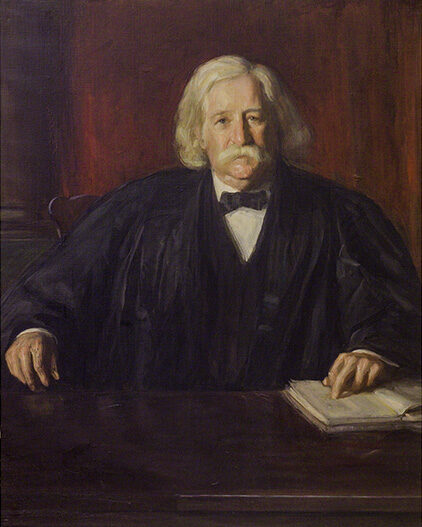
Featured image: Official portrait of Chief Justice Melville W. Fuller. Courtesy of the Collection of the Supreme Court of the United States.
Cushman, Clare, ed. The Supreme Court Justices: Illustrated Biographies, 1789-2012. Third Edition. Thousand Oaks, CA: CQ Press, an imprint of SAGE Publications, 2013.
Ely, James W., Jr. The Chief Justiceship of Melville W. Fuller 1888-1910. Columbia, South Carolina: University of South Carolina Press, 1995.
Ely, James W., Jr. “The Fuller Court and Takings Jurisprudence.” Journal of Supreme Court History, 21-2: 120-135 (1996).
Ely, James W., Jr. “Melville W. Fuller Reconsidered.” Journal of Supreme Court History, 23-1: 35-49 (1998).
Lochner v. New York, 198 U.S. 45 (1905)
Loewe v. Lawlor, 208 U.S. 274 (1908)
Morris, Jeffrey B. The Era of Melville Weston Fuller. Supreme Court Historical Society Yearbook, 6: 37-51 (1981).
Peppers, Todd. “Chief Justice Melville Weston Fuller and the Great Mustache Debate of 1888.” Journal of Supreme Court History, 45-2: 140-150 (2020).
Plessy v. Ferguson, 163 U.S. 537 (1896)
“Plessy v. Ferguson.” Oyez. https://www.oyez.org/cases/1850-1900/163us537.
Pollock v. Farmers’ Loan & Trust Co., 157 U.S. 429 (1895)
Rooks, Douglas. Calm Command: U.S. Chief Justice Melville Fuller in His Times, 1888-1910. Thomaston, ME: Maine Authors Publishing, 2023.
United States v. E.C. Knight Co., 156 U.S. 1 (1895)