Belva Lockwood
Life Story: 1830-1917
The educator, activist, and attorney who became both the first woman to argue before the Supreme Court and to run for President of the United States.
Background
Belva Ann Bennett was born in Royalton, New York, on October 24, 1830. Her parents, Hannah and Lewis J. Bennett, often moved their five children around upstate New York in search of steady farm employment. Belva demonstrated determination and hard work from a young age; however, her father did not encourage her to excel in school because society expected young women to focus on marriage and child-rearing. The lack of support did not deter her from pursuing an education. At the age of 14, she began working as a teacher to help support her family. She earned just $8 per week—less than half the pay of her male colleagues. The pay disparity frustrated Belva and served as a catalyst for her future efforts toward women’s equality. At 18, she married Uriah McNall, and they farmed and operated a sawmill in Gasport, New York. As a young wife, she thought about women’s rights and described marriage for women as “the end of her personality, or her individuality of thought and action.” She fought to keep her sense of self by reading books and writing articles, which led some to accuse Belva of having “unwomanly habits.”
Belva and Uriah had one daughter, Lura, in 1849. Three years later, Uriah died from illness after a mill accident. Now a widow and a single mother, Belva needed to provide for herself and her young daughter. In 1854, she sent Lura to live with her parents in Illinois and resumed her education and career. She received special permission to attend the local, all-male college (now Syracuse University) and graduated with honors in June 1857. After graduation, she worked as a teacher and earned enough money to move her daughter back to New York.
Belva became the headmaster of the girls’ department at Lockport Union School, aiming to provide more opportunities for young girls through a rigorous curriculum. At a local school meeting, she met Susan B. Anthony, a fellow educator and future leader in the women’s suffrage movement. Together, they developed an experiment to offer girls at Lockport a public-speaking class similar to one provided to boys. The results convinced the state of New York to implement public-speaking classes for all students. Later in life, Belva remarked that as a female lawyer, she would have significantly benefited from a class like the one she implemented in Lockport. Belva left Lockport in 1861 and taught at two other New York schools during the Civil War, where she ran campus efforts to provide aid for Union soldiers.
A Path to Law: Moving to Washington, D.C.
In 1866, after the war ended, Belva and 17-year-old Lura moved to Washington, D.C. With her grown daughter as her aide, she founded the McNall Ladies’ Seminary, believing “a rigorous education can alter women’s lives and make them financially independent.” Meanwhile, she pursued interests in law and public policy. Each day after classes, she would walk to the Capitol and observe Congress in session. During this time, Belva met Ezekiel Lockwood, a Civil War veteran, reverend, and local dentist-turned-legal advocate, and they married in 1868. They shared an interest in social reform and collaborated on advocacy efforts to help the working class. Alongside Ezekiel, Belva gained experience as a notary, pension and claims agent, and court-appointed guardian.
After receiving an invitation to a law school lecture, Belva decided to leave teaching and pursue a second career as a lawyer. In a published 1888 autobiographical article, she recalled her younger self as having “all the ambitions of a man, forgetting the guilt between rights and privileges of the sexes.” Belva learned of a vacancy in the consul’s office in Ghent, Belgium, and applied directly to Secretary of State William Seward for the position, even though women could not vote and rarely participated in politics at the time. Although her request was never acknowledged, she remained undeterred. This wasn’t the last time she challenged the federal government’s hiring practices.
In 1871, Belva enrolled at the National University Law School in Washington, D.C., one of 15 women in its first co-ed class. Two years later, she was one of only two women to finish their studies. The school, however, refused to issue her a degree. Even without her official degree, the District of Columbia Bar Association recognized Belva as a graduate, just as they did for all local law graduates. While advocating for her degree, Belva worked as a journalist and traveled throughout the South reporting on Horace Greeley’s presidential campaign for The New York Tribune. Her experiences broadened her perspectives about government, campaigning, and journalism. Over the next year, Belva continued to demand her diploma; without it, she could not expand her practice outside D.C. In 1873, she appealed the school’s decision to withhold it directly to President Ulysses S. Grant, the school’s ceremonial chancellor. One week later, she finally received her law degree.
Lobbyist, Lawyer, and Presidential Candidate
Belva started her own law practice in Washington before being officially admitted to the bar. Lura and Clara Bennett, Belva’s niece, served as her legal assistants. She served working-class clients, representing them in divorce cases, pension claims, and cases involving marginalized individuals. At the peak of her legal career, she reportedly earned $3,500 per year, a significant amount compared to the average annual income of $500 for most families in the late 1800s. Although most of her cases were civil, she also handled criminal cases. She often traveled to represent her clients and relied on clerks and other lawyers to keep her law office running. She quickly became known as the district’s “lady lawyer.”
After obtaining her law degree, Belva applied to bar associations in nearby states. Meanwhile, she lobbied Congress to enact reforms for working-class Americans. Belva often did not advocate for popular causes, but rather for those essential to her moral beliefs. She challenged the status quo, questioning those in power who represented the interests of the working class. She opposed legislation leading to the disenfranchisement of thousands of women in Utah, as well as the 1882 Chinese Exclusion Act. Her assertive personality and willingness to take on high-profile cases helped build her reputation in Washington, D.C, with both politicians and the general public. Belva promoted legislation for equal employment rights for female federal workers. She arranged private meetings with Congressmen, sharing her own experiences as a teacher paid less than her male colleagues. Simultaneously, she gained public support for the bill via newspaper articles and petitions. The law passed in 1872.
As the candidate for the National Equal Rights Party in both 1884 and 1888, Belva became the first woman to run a full presidential campaign in the United States. When asked why she ran for president, Belva said, “It is quite time we had our own party, our own platform, and our own nominees. We shall never have equal rights until we take them, nor respect until we command it.” Her platform supported causes such as women’s rights, civil service reform, protection of public lands, temperance, and the federalization of family law.
While Belva supported women’s rights organizations, she also became a prominent voice in the pacifist movement. Her leadership and advocacy on behalf of the Universal Peace Union helped the United States and other nations recognize the need to create a permanent international arbitration court to resolve disputes between countries.
Supreme Court Advocacy
In 1876, Albert G. Riddle, a close ally of Belva’s, stood before the Supreme Court and moved to have her admitted to its bar. Chief Justice Morrison Waite denied the request, stating that “none but men are admitted to practice before it as attorneys and counselors,” based on the Court’s “uniform practice.” In response, Belva successfully campaigned for a bill banning discrimination against female attorneys. Congress introduced “the Lockwood Bill” in January 1877, and it became law the following year. Sadly, amid her success, Ezekiel died. On March 3, 1878, Chief Justice Waite administered the oath to Belva as a member of the Supreme Court Bar. Over the next few decades, Belva appeared at the Court to request membership in the Court’s bar for other applicants, including Samuel Lowry, the second Black attorney admitted to the Supreme Court Bar, just as Riddle did for her.
Belva became the first woman to argue at the Supreme Court in 1880 in Kaiser v. Stickney. She participated as co-counsel for local D.C. resident Caroline Kaiser in an appeal challenging a $16,000 debt. Kaiser believed her debt was void because married women could not legally enter into contracts. Regardless of her thoughts on women financially supporting themselves, Belva believed Mrs. Kaiser could appeal the lower court’s decision. Belva’s attempt to persuade the Justices to rule in favor of her client failed; she lost her first appeal before the Court.
Twenty-five years later, Belva argued for two days in front of the Justices in United States v. Cherokee Nation (1906). The U.S. government owed the Cherokee Nation over $5 million for relocating the Eastern Cherokee, and in 1891 refused to pay the remaining balance of $1.1 million. Belva represented members of the tribe, and when the case reached the Supreme Court, the Justices issued a unanimous decision in favor of the Cherokee Nation. Unfortunately, the lawyers working with Belva negotiated their fees without her involvement, resulting in a much smaller payment for her services.
Legacy
Belva remained active and dedicated to reform throughout her life. In 1906, Syracuse University awarded her a doctorate of law degree, the highest honor ever given to a woman in the country at that time. At 82, she led a group of 20 women to Europe to participate in an international peace movement conference. Belva Lockwood died on May 19, 1917, at the age of 86, three years before women earned the right to vote with the ratification of the Nineteenth Amendment. During a time when society expected women to stay in the home, Belva forged a path in public life. From congressional lobbying and practicing law to becoming the first woman to argue before the Supreme Court, Belva never shied away from demanding the recognition and respect she deserved. Her work inspired generations of female lawyers, politicians, and activists, setting precedents for future women in law and politics.
Discussion Questions
- How did Belva challenge traditional female roles from a young age?
- Identify two ways that Belva advocated for herself in her career. In what ways did Belva persevere through adversity?
- Belva ran for president as a third-party candidate, knowing she would not win. Why did she campaign if the chances of her winning were slim?
- How did Belva leverage her connections with different groups of people to advocate for the interests of the working class?
Extension Activity
In 1881, Belva shocked many when she rode a tricycle around the streets of Washington, D.C. An avid health enthusiast from a young age, she valued exercise and was unafraid of publicity. President Grover Cleveland even went so far as to demand that the wives of his cabinet members not ride a bicycle.
-
Research political cartoons, advertisements, and broadsides relating to Belva Lockwood’s life.
-
Describe how these forms of communication promoted her work.
Sources
Special thanks to Clare Cushman, Director of Content & Media at the Supreme Court Historical Society, for her review, feedback, and additional resources.
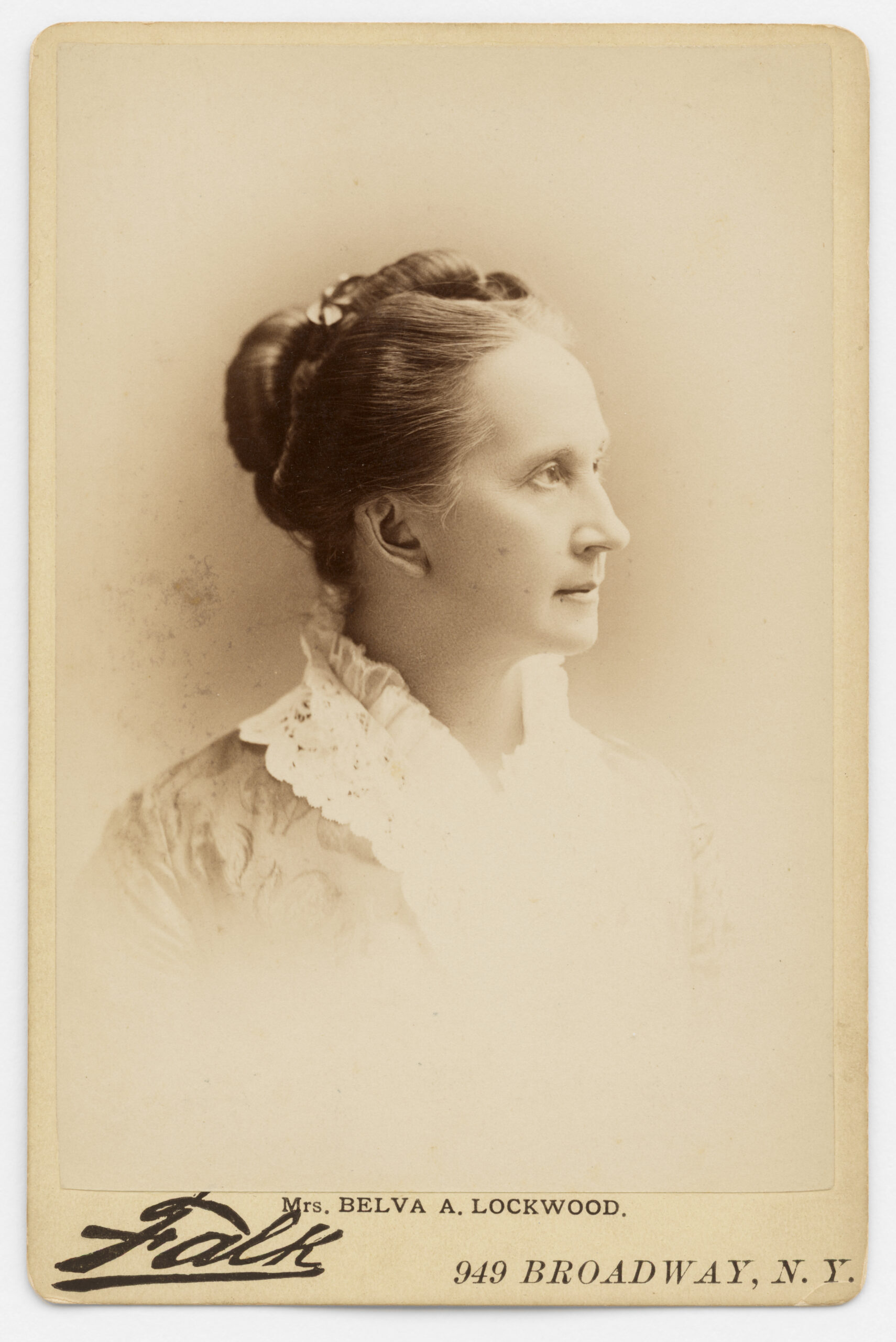
Featured image: Falk, Benjamin Joseph. “Belva Ann Lockwood.” Photograph. 1880. National Portrait Gallery, Smithsonian Institution. https://collections.si.edu/search/detail/edanmdm:npg_NPG.80.298.
“‘Belva Lockwood: From Log Cabin to the Supreme Court.’” National Women’s History Museum. PowerPoint presentation. Accessed October 21, 2025. https://www.womenshistory.org/sites/default/files/document/2024-03/FINAL%20Belva%20Lockwood%20PP.pdf.
Cushman, Clare. “Women Bar Members and Advocates.” Essay. In Supreme Court Decisions and Women’s Rights: Milestones to Equality, 215–19. Washington, D.C.: CQ Press, 2011.
“In Re Lady Lawyers: The Rise of Women Attorneys and the Supreme Court.” Home – Supreme Court of the United States. Accessed October 21, 2025. https://www.supremecourt.gov/visiting/exhibitions/LadyLawyers/Section2.aspx.
Lamberson, Christine. “A Woman Appears In the Supreme Court: Belva Lockwood’s Career in the Federal Courts.” Federal Judicial Center. Accessed October 21, 2025. https://www.fjc.gov/history/spotlight-judicial-history/belva-lockwood.
Lockwood, Belva Ann. “My Efforts to Become a Lawyer.” Lippencott’s Monthly Magazine XLI, no. 1 (June 1888): 215–29. https://msa.maryland.gov/megafile/msa/speccol/sc3500/sc3520/015800/015841/pdf/lippincott.pdf.
Norgren, Jill. Belva Lockwood: The woman who would be president. New York, NY: New York University Press, 2008.